# Why self-sufficiency and anarchism are direct responses to the failure of the West?
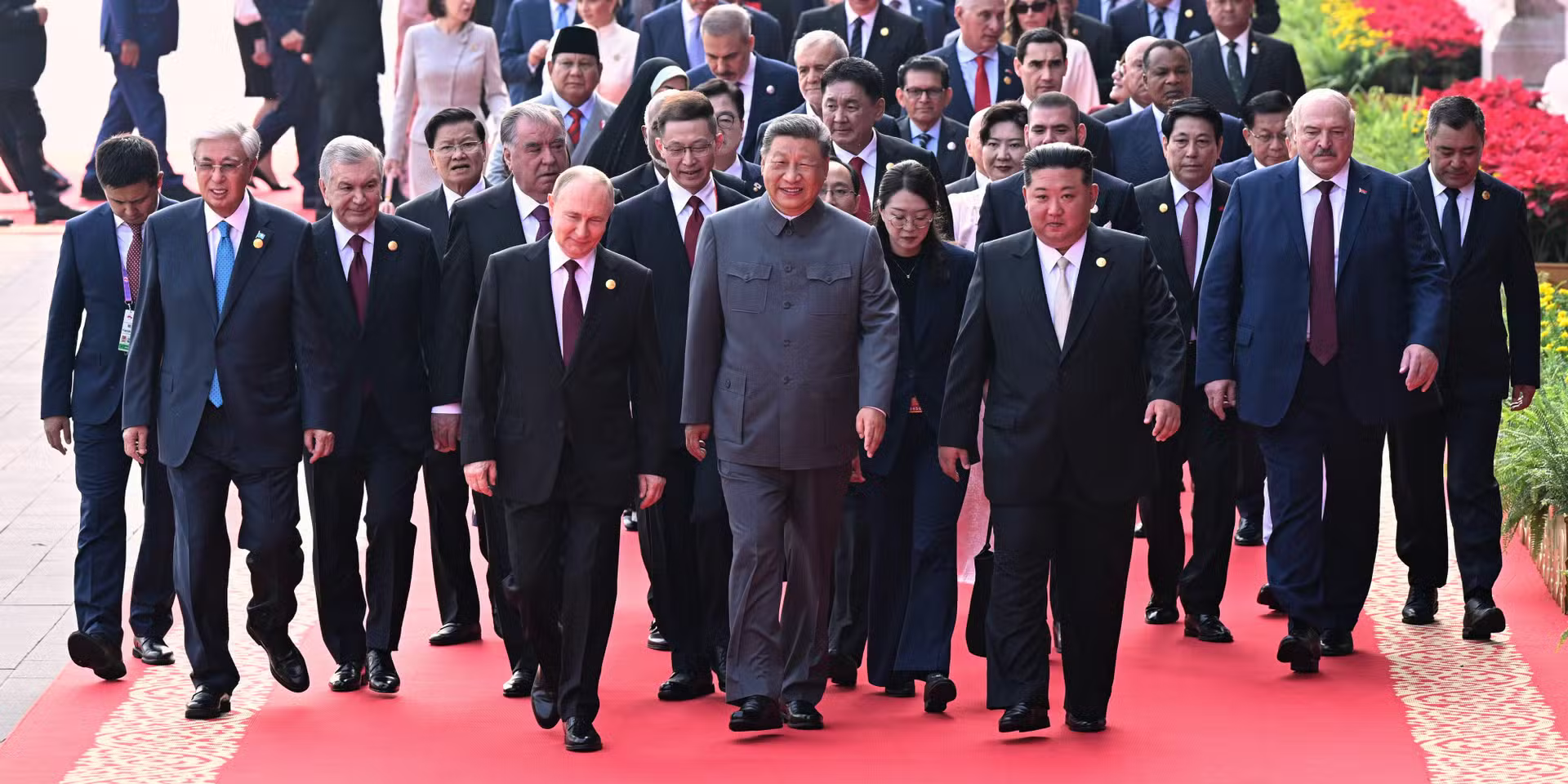
It is now quite clear for several years that the West is in the process of failing. However, this failure has become increasingly evident over the past few months and is, for me, perfectly illustrated by this photo:
Xi Jinping, Putin, Kim Jong Un, and Lukashenko walking side by side to celebrate the 80th anniversary of the end of World War II, in front of the Great Wall of China on September 3, 2025
Where we said 35 years ago -- following the fall of the Berlin Wall, the separation of certain states from the USSR and, in the end, the end of the USSR -- that the West had won and that neoliberal capitalism had triumphed, what is the situation today? Could it be that this Western arrogance was too hasty? What future awaits the West? How could it have been otherwise? And why are concepts like anarchism or self-sufficiency a clear, direct, and coherent response to this failure?
## From a Victorious West to the Abyss
Following the end of the Second World War, the Cold War emerges. The political world is divided into 2 ideological blocs (excluding those trying to develop): the West and the East.
The West representing the United States, capitalism, the "democracy", the "freedom", and the East representing the USSR, socialism (from a Marxist point of view: the proletarian dictatorship, a transitional phase towards communism), a single party, a strict control of public speech.
Of course, this is the description made by the West of the Cold War, because the "Free world" had at many moments had very questionable actions: "Vietnam War", "Korean War", ["Valuable Project"](https://en.wikipedia.org/wiki/Operation_Valuable), [the](https://en.wikipedia.org/wiki/First_Taiwan_Strait_Crisis) [multiple](https://en.wikipedia.org/wiki/Second_Taiwan_Strait_Crisis) [interventions](https://en.wikipedia.org/wiki/Third_Taiwan_Strait_Crisis) [in](https://en.wikipedia.org/wiki/Operation_Beleaguer) [China](https://en.wikipedia.org/wiki/1959_Tibetan_uprising), [the numerous coups d'État/invasions in Latin America to prevent the left from winning](https://en.wikipedia.org/wiki/United_States_involvement_in_regime_change_in_Latin_America), "Bay of Pigs", ["Operation Eagle Claw"](https://en.wikipedia.org/wiki/Operation_Eagle_Claw), ["Ñancahuazú Guerrilla"](https://en.wikipedia.org/wiki/%C3%91ancahuaz%C3%BA_Guerrilla), ["Operation Cyclone"](https://en.wikipedia.org/wiki/Operation_Cyclone) and without forgetting the bombing of Hiroshima and Nagasaki, to cite only the most known examples during or just before the Cold War.
One of the major objectives during the Cold War was to have as many allies as possible and to **expand** its influence as much as possible in the world. This race for ideological world domination is indeed the cause of many military conflicts, such as the Vietnam War for example. The West stretching from Europe to North America, to Oceania and Taipei-Seoul-Tokyo, and the East covering Eurasia, from Berlin to Shanghai as well as La Havana (Cuba). However, today everyone seems to know that the USSR is no longer: the West has won.
Despite this, the history of the USSR's defeat is somewhat complicated and very little known. In the 80s, the USSR starts to be technologically behind, especially in its armaments production. President Ronald Reagan would then launch an arms race that would force the USSR to sign a reduction in the world's arms production: the USSR bends before the United States. A symptom of a Soviet decline struggling to cope with the United States' growth. Then, the decisive turning point would occur shortly after the arrival of Gorbachev. This latter wanted to make the USSR more capitalist and democratic without sufficient anticipation of the consequences. One can be a convinced democrat and consider that it was not a good idea, because when you convert overnight a country where repression is one of the main means of control, to a state where everything can be said, then this would inevitably create a lot of uprisings. Moreover, opening the USSR to international markets without the economy and industry of this country being made for that did not help. It also greatly reduce the budget given to Eastern Europe as well as Cuba. These questionable choices lead to the USSR's defeat in a few months (1988: beginning of new reforms, 1989: fall of the Berlin Wall, 1990: first states separating from the USSR, August 1991: Moscow coup, 25 December 1991: End of the USSR).
> [!NOTE]
> Following his disastrous mandate, Gorbachev will keep an enormous unpopularity even after decades without mandate.
The victory of the West over the East seemed to mean the total domination of the West over the World, an unstoppable force that could not be stopped or dominated. What was really the case? The impoverishment as well as the end of the USSR were indeed symbols representing the United States' domination over the world at that time: economic, military, influence, etc. The post-USSR period was marked by many United States' actions aimed at continuing to increase their advance. However, even though things could appear as simple: "the West won, the East lost", things were much more complicated. What we forget in this rather basic schema, is **China** (中国). We often tend to think that China was part of a potential large East bloc, in reality, China had been gradually moving away from the USSR for decades, and even if the resignation of Deng Xiaoping (邓小平) following Tienanmen square (May-June 1989) coincides with the first uprisings of Soviet states, the Chinese and Soviet situations have little to do with each other.
### China as the Hope of the East
The Maoist period as well as the Cultural Revolution were very harsh and killed millions of people, and this is even acknowledged by China today[^5]. Despite this, it is still important to note that this period also, through an iron hand, broke the feudal structures and laid the foundations for mass literacy through the reform of the Chinese language. However, if China is what it is today, it is largely due to a man: Deng Xiaoping. Following the Maoist period, Deng Xiaoping immediately created the period of 拨乱反正 (bōluàn fǎnzhèng, _litterally_: eliminate the chaos and return to normality). During this period, an economic reform program (改革开放, gǎigé kāifàng) will be included. This reform consisted of 3 major points:
1. Maintain socialism -- in the sense: State possessing the means of production. This implies constant or increasing investment in Chinese enterprises.
2. Opening up to foreign investments and opening up to exports.
3. Massive reinvestment in education.
These different reforms allowed China to start anew on stable foundations and, gradually, to escape famine and move towards a healthier future. Beyond the current situation that was beginning to improve, the pillars for becoming an international power were already in place. And the more China became productive and self-sufficient, the more it exported. One can note, for example, its entry into the World Trade Organization (WTO) in 2001 under Jiang Zemin (江泽民). Gradually, it gained prominence on the international market, becoming in 2004 the first Asian exporting country, in 2010 the first Asian economy, and in 2012 the world's leading exporting country.
From a Western perspective, the Chinese political model is fundamentally flawed: no democracy and reduced freedoms. This criticism can make sense, and one can imagine other models that would be better, but instead of focusing on the fact that the Chinese model violates what the West venerates, what are the advantages of this model? In reality, it may seem immoral to explain why this model can make sense, but it is absolutely essential if one wants to understand China.
#### For the Interest of the People
The [Chinese Communist Party](https://en.wikipedia.org/wiki/Chinese_Communist_Party), unlike the majority of authoritarian regimes, understood that, if they want to increase their power and global influence, citizens must be in good conditions and live in peace. This is why there has been a genuine interest from the Chinese Communist Party to ensure that life in the country is good for citizens. And since Deng Xiaoping, one can clearly see the evolution of the Chinese standard of living as well as average living conditions, which have greatly evolved to satisfy the majority of the Chinese people[^1]. Beyond daily life, education has truly been prioritized for decades, and today's Chinese university results are a demonstration of this investment (ex: Mathematics[^7]).
#### A coherent direction over time
From a Western perspective, it is necessarily a bad thing that there is only one party deciding for decades. However, this allows China to have a very coherent direction, and this has been the case since Deng Xiaoping (although one can observe some changes in priorities with the different presidents). However, compared to the radical changes of regimes that can occur in the West when an opposing party wins (ex: Republican vs Democrat in the United States, Labour vs Conservative in the United Kingdom, etc.), China has a real political stability and consistency: this is due to the law of the single-party system as well as a very repressed contestation.
On the contrary, the West is entering an increasingly unstable political and institutional phase -- which directly affects the economy otherwise --, and where, in the end, the far-right takes or will take power in most of the West, which is contrary to the interests of the people.
#### No foreign destabilization
If censorship is instinctively perceived as oppressive in the West, it takes another dimension if one considers that the Party benefits from its people being cultivated and not destabilized by propaganda. The example of [TikTok](https://en.wikipedia.org/wiki/TikTok) is striking: although [ByteDance](https://en.wikipedia.org/wiki/ByteDance) is a Chinese company, the Chinese government prohibits the international version on its territory in favor of _Douyin_, a more educational and limited to 40 minutes version for young people[^10]. Where the liberal ideal bets on the self-regulation of the individual, the Western reality shows a youth and an increasingly older user base captivated by dulling algorithms.
Beyond this "mental hygiene" national, this information control is a sovereign shield. Without this digital barrier, China would be vulnerable to destabilization campaigns and American _soft power_ aiming for regime change (even Europe recognized American destabilization when Musk advocated for the AfD in January 2025, but American destabilization has also recently been seen [in Argentina](https://en.wikipedia.org/wiki/2025_Argentine_legislative_election) or in Venezuela, in short, the list is long). By limiting access to toxic social networks and time-consuming video games, China protects the reflection capacity and productivity of its population. Facing an Occident where school results are falling and attention is collapsing, criticizing the Chinese model without recognizing its protective effectiveness amounts to ideological blindness.
#### Reduction of frauds
In the West, tax optimization, or even tax evasion by the "elites" is common practice. Unlike China, where the Chinese State is the elite and has no interest in allowing these tax schemes to thrive, since the money that leaves to tax havens is the money that the party loses and cannot reinvest to grow. Therefore, there is no tolerance, not by virtue, but purely out of the interest of the regime's survival. Whereas in the case of the West, presidents or prime ministers are not directly impacted by the decrease in state revenues (as long as it remains modest), since it is more important for them to be on good terms with billionaires to gain more power. Tolerating a certain form of tax evasion for the very wealthy is simply a rational action when the goal is power. Unlike China, which has no interest in losing this potential source of revenue since it directly impacts its power and growth, not only as a nation, but also as individuals and as investment in their future.
### The Western Collapse
The equation between the West and China is not unbalanced solely due to the performance of the Chinese system, but is also due to a certain form of disintegration of what was once the West.
The event that best represents the first real Western failure is the 2008 stock market crisis. This economic crisis is characteristic of the defects of liberal capitalism, as we also saw in 1928 and 1848. This economic crisis will have very important lasting consequences on the West, particularly in Europe where inflation will be felt and the technological and innovation debt will be marked forever. This is entirely illustrated by the near-total absence of major innovations in the decade following the stock market crash.
This major upheaval and the inability of Western leaders to remain in a form of untouchable economic domination, a foot in the financial stables, will undoubtedly lead to a growing sense of rejection towards what people consider to be the political caste that caused all this turmoil.
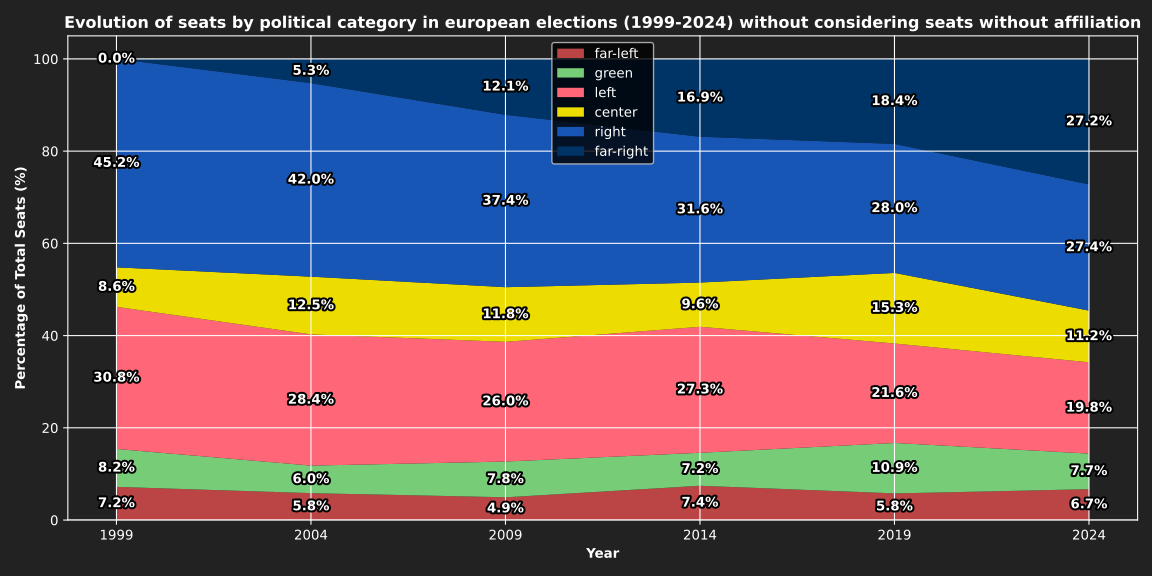
From now on, to talk a bit more about concrete things rather than staying in the abstract, we will rely on empirical data: the results of European elections since 1999. These data serve, in my opinion, mostly to give political trends. It is not relevant to focus on small fluctuations because it can be due to a political party that won in an influential country in Europe (ex: Germany, France, Italy, Spain) or just a different alliance.
Evolution of seats by political category during European elections (1999-2024) without considering unaffiliated seats. Red => Far Left, Green => Ecology, Pink => Left, Yellow => Center, Blue => Right, Dark Blue => Far Right
One can see that in 2004, the extreme right only had 5.3%. This is already an important score, but quite minor compared to the score of 12.1% (x2.28!!) achieved in 2009. One can see in this result the direct impact that the 2008 crisis had as well as the progressive consequences over time of this policy with a rather constant but quite "soft" increase of the extreme right over 10 years (12.1% (2009) => 18.4% (2019)), even though it remains an increase of 6.3%, which is less than the progression between 2004 and 2009 (12.1% - 5.3% = 6.8%). The other figure that can mark is the evolution from 2019 (18.4%) to 2024 (27.2%) which corresponds to an increase of +8.8%. This is an extremely important increase that is due to 3 very important factors that have harshly marked the West: the COVID-19, the Russo-Ukrainian war, and the democratization of social networks.
#### COVID-19
The health and economic crisis linked to COVID-19 has been a very important fuel for the far-right. First of all, because even though some countries have managed the crisis better than others, in each country there have been: either deaths, or significant debts. Whether it is debt or deaths, both favor the emergence of a significant distrust -- legitimate or not. Especially since the debts incurred by many European countries are still very significant (ex: in the eurozone from 2019 to 2020, debt increased by 12.9% of GDP (increase of 14% in debt), knowing that from 2020 to 2024, there has been a decrease of 8.5% in debt, there remains therefore still 5.5% of debt to repay due to COVID[^6]), and can constitute a brake on growth.
Beyond this very important monetary aspect, another phenomenon has emerged that had probably never reached such a level before: generalized conspiracy theories. My goal is not to do primary anti-conspiracy, because historically, there have been examples (ex: Edward Snowden 2013) of conspiracy theories or at least of _unfounded fears not directly supported by facts_ that turned out to be true. Moreover, it is important to recall that "the absence of evidence is not evidence of absence," especially when governments intentionally try to hide some of their actions. But this does not mean that believing in a conspiracy, by its nature dissenting, is a good thing. Especially when it is linked to science and experimentally it is false.
Conspiracy theories have been for many a contested refuge accessible against governments, unfortunately ignoring that it is entirely possible to criticize the management of a health crisis from the government without necessarily questioning science, the true.
But if conspiracy theories have spread so much during this period, it is not only because of a poor management of the crisis in terms of actions, but also due to a lack of rigor from the different governments, which have often been more in the affirmative than in a manifest scientificity. This goes hand in hand with the main problem of democracies: when there is not enough education, factual media, and when there is too much disinformation and uncontrolled and free data, democracy dies. Democracy is then no longer the governance of the people (even though historically it has never been durablely and institutionally the governance of the people), but the governance of those who possess education and information. And conspiracy theories have a perfect synergy with this vice of democracy. That is why the period of COVID-19 has been an important moment for alternative information networks, conspiracy theories on social networks, and the alignment of these thoughts to the far-right.
#### War in Ukraine
The war in Ukraine has also been a lasting turning point for the far right. Even though the arrival of this war may have temporarily lowered the far right and created a unity and sovereignty of Europe, the long-term results are somewhat different. The inflation and the economic impact caused by the war in Ukraine have been very noticeable and are still measurable in Europe. This directly affects people with modest incomes and has exacerbated the difficulties of living decently. Moreover, these loans and debts incurred for Ukraine have no visible effects or consequences, and this, in a context of a stagnant war, or even one that is unfavorable to Ukraine. The far right, which likes to use such events to fuel its anti-system discourse, has content it can use.
#### The advent of social networks and post-truth
Lies and the impunity of these latter are as many reasons that make the far-right more suitable to become popular. When, what counts, is no longer what is true or what is false, but what we like to believe, then one risks to detach from reality. It is a risk of drift extremely important that takes us away from the real solutions to our problems. Moreover, when information is sometimes held by people who have particular interests. We no longer believe what we want to believe, but we unconsciously believe what other people want us to believe. We are then already no longer in democracy but in the government of those who dominate and who impose their ideas and their questions on the public debate. Because, there is no freedom without truth. The one who deciphers the functioning of the world rises above the determinisms and understands how the human mind -- his own as well as others' -- can be trapped, how culture influences us, how the World functions. Knowledge is the key to our sovereignty. If we abandon it, we open the door to the totalitarian nightmare described in [1984](https://en.wikipedia.org/wiki/Nineteen_Eighty-Four).
The act of stripping truth of its importance has been particularly evolved during the last decade. Of course, politicians have not always been honest people, and I think that we all probably have in the West this perception or memories of political personalities distorting the truth. The main difference is that since less than a decade ago, lying has become commonplace and even worse, it has gradually become acceptable, whereas truth is becoming less and less important. What comes first is no longer truth, but what I -- as a citizen -- want to believe, regardless of the facts. It is not just a minor change, it is a paradigm shift, and that is post-truth: a new paradigm where lying has become acceptable. Social networks have contributed to this by creating [echo chambers](https://en.wikipedia.org/wiki/Echo_chamber_(media)#). More pernicious than a simple censorship filter contradicting, these rooms act as a permanent validation system, constantly reinforcing our existing biases. This mechanism, far more destructive for critical thinking, has paved the way to a new era of disinformation.
We will take 2 international examples that probably everyone knows to illustrate the impunity of lying and the era of post-truth.
##### Donald TRUMP
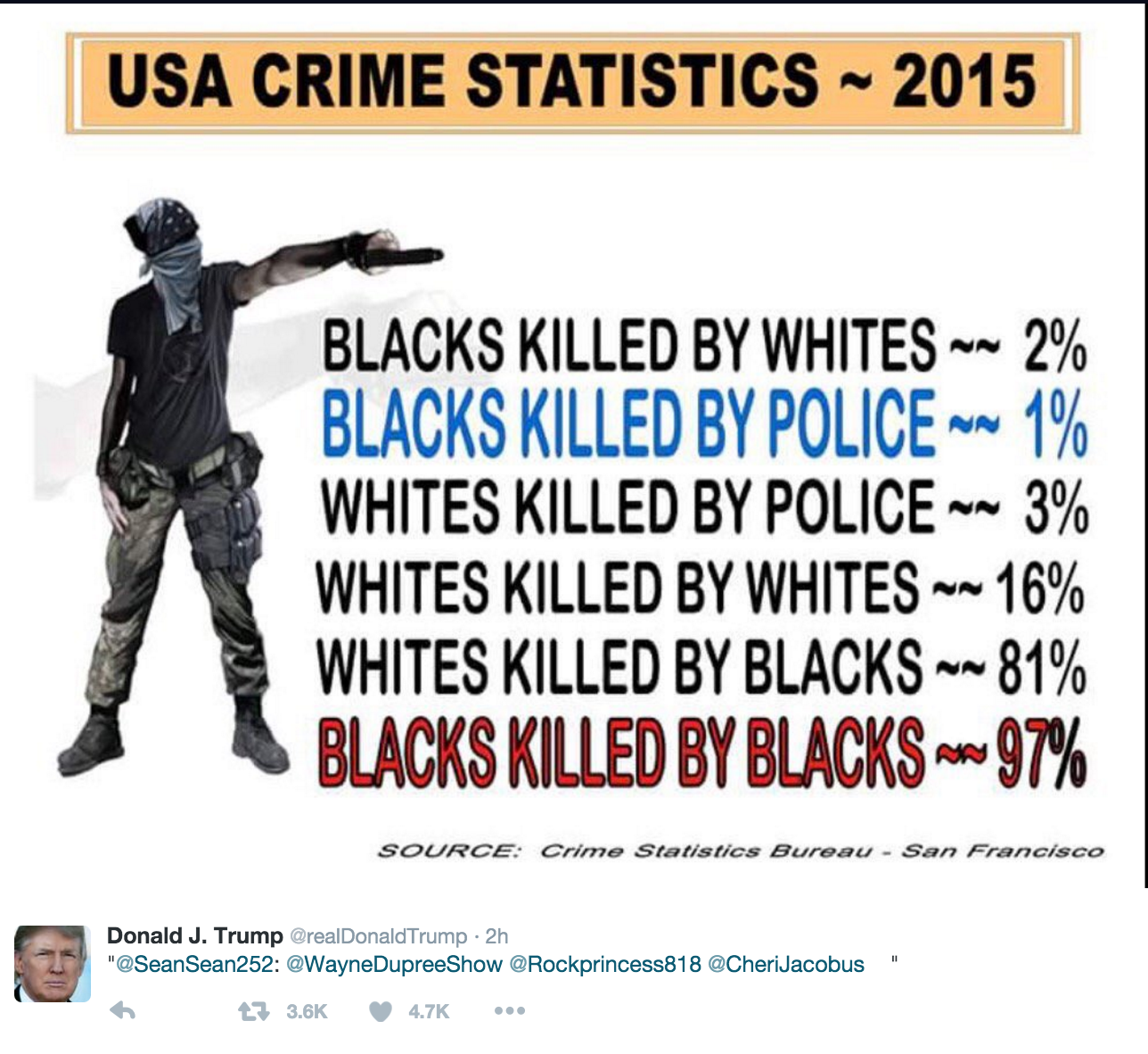
[Donald TRUMP](https://en.wikipedia.org/wiki/Donald_Trump) is a very telling example of how lies have evolved from arrangements meant to hide a scandal – a lie filled with shame – into a flood of lies without any remorse or prudence. Let's take a factual example, a case study, that everyone can verify.
Trump tweeted in November 2015[^11] the following:
Photo of statistics: "USA CRIME 2015" relayed by Trump on Twitter in 2015[^11]
What makes this example interesting is that Trump mentions precise figures and that the FBI maintains a list of all homicides by ethnicity and sex[^12]. It is therefore possible to affirm or deny this easily. Here is the difference between Trump's figures and the official figures:
| Attacker -> Victim | Trump's Figures | Official Figures |
|---|---|---|
| White -> White | 16% | 81.28% |
| White -> Black | 2% | 8.60% |
| Black -> White | 81% | 15.79% |
| Black -> Black | 97% | 89.34% |
This is not just a simple lie, but a diametrical inversion of the truth for xenophobic, if not racist, purposes to fuel racial fears and rejection of the other. Even though this happened in 2015, it is verifiable and known that it is a lie, Trump has still repeated it and been re-elected. He has never deleted his Tweet, and has never apologized for it to my knowledge. This brazen tweet, which previously would have been an argument used by all the opposition to ridicule Trump, is no longer even shocking today; we just say "that's Trump". The Washington Post has counted 30 573 lies or half-truths during his 2016-2020 mandate (~21 / days)[^13], so this lie is not an isolated case, and shows a vast ocean of falsehoods. Even during his address to the nation on December 17, 2025, Trump continues to lie without any remorse[^14]. Trump lies, and the people continue to vote for him even though he distorts the truth, because the truth no longer matters much.
##### Boris JOHNSON
[Boris JOHNSON](https://en.wikipedia.org/wiki/Boris_Johnson) emerges politically during a period similar to that of Trump without there being a direct link between the two. He became well-known primarily during the [Brexit](https://en.wikipedia.org/wiki/Brexit) by deliberately and repeatedly lying. His lies were picked up by numerous media outlets and quickly proven to be false, such as the argument of 350M£ sent to Europe and the ["Vote Leave bus"](https://en.wikipedia.org/wiki/Vote_Leave_bus). The message conveyed by this bus was that the United Kingdom "sent" 350M£ to Europe every week. Johnson claimed he wanted to leave Europe to reinvest this money directly into the country. However, saying this is both simplistic and false. Simplistic because one cannot reduce the economy to a subtraction and false because the figure was likely 100M£ to 200M£ lower[^15]. Even [Nigel FARAGE](https://en.wikipedia.org/wiki/Nigel_Farage) – fervent supporter of Brexit and leader of [Reform UK](https://en.wikipedia.org/wiki/Reform_UK) – will say a few hours after the vote that this was not realistic and that it was a "mistake"[^16]. However, even though it was recognized as manipulation of public opinion and that it undoubtedly played a role in the vote, Johnson was not disqualified or sidelined: quite the opposite. In 2019, he was rewarded by becoming the Prime Minister of the United Kingdom and continues to lie _ad nauseam_. He claimed in November 2021 that there are more people in employment than before the COVID-19 pandemic, although there were 600 000 fewer, and reiterated this lie before parliament. He claimed to create 40 hospitals by 2030 (without advancing how to do it concretely) – then, a few years later, the project was canceled as unrealistic. He lied about his knowledge of the "Party-gate" during the COVID-19 crisis while the country was under lockdown. The same strategy: lie, lie, lie.
## What future for the West?
> [!NOTE]
> _This section will purely be speculative, it does not constitute any financial advice or truth; it is simply my political thoughts projected into the future._
I think that the far right will continue to gradually rise across all of the West. It will take power in Germany with the AfD, in France with the RN or a union of the right, in the United Kingdom with Reform UK or a similar party, as well as gradually in many other countries. It will maintain its grip in Argentina, Italy, Hungary, Poland, Austria, and Trump is trying to do the same in the United States. Even though it is not guaranteed that every country in the European Union will fall under the far right (ex: Sweden is quite unlikely, Ireland, Luxembourg), only a majority of influential countries leaving the European Union can create a shift in stability.
The far right will probably fragment Europe little by little, as Brexit did, and as Trump is doing currently (2025). One can notably note:
- Brexit (Boris Johnson, Nigel Farage) -- United Kingdom
- Frexit (Marine Le Pen (2017)) -- France
- Nexit (Geert Wilders) -- Netherlands
- Dexit[^2] (AfD) -- Germany
As well as quotes from many political personalities who say that Europe is a hindrance, as Matteo Salvini:
> We do not need a strong man. But we need a strong country that is not subordinate to Europe. With its own currency, for example.
The fragmentation of Europe as well as the disappearance of important members will greatly weaken its power, its economic stability, or even its survival. To nuance this position, I do not say that the arrival of the far right necessarily implies a direct exit from Europe, but most parties still want to distance themselves from Europe, or at least nullify its influence on their politics. Moreover, trying to pursue economic sovereignty when the majority of your economy depends on imports will inevitably lead to a certain economic recession and uncontrolled decline. Not that this is fundamentally bad in itself, it can be seen as progress (_a chosen decline_) that fits into a form of left-wing anti-capitalism, but it is unnecessary to mention that this is not the project of the far right that will be more victim of a _recession suffered_. Beyond even resulting in a possible recession, what is sure is that growth will not increase. As for China investing in new technologies and industries of the future as it has never been seen before (ex: [Shenzhen 深圳市](https://en.wikipedia.org/wiki/Shenzhen_Special_Economic_Zone)), **a fragmented Europe has no chance of keeping a form of power or economic domination**. Even if Europe and the United States boycott 100% of China, it would represent "only" 28%[^3] (in 2023) of its income coming from exports. A 100% boycott of China is "impossible" because the West depends on essential elements for its functioning, ex: medicines, computers and all kinds of electronics, new energies, cars, _etc._ . 28% is a lot: yes. But not enough to put it on its knees. Especially since on October 23, 2025[^4], regarding the 2026-2030 plan, Xi Jinping announced wanting to have a form of national self-sufficiency (=> less dependent on the West and diversify its sources of income). Without forgetting that China has been diversifying its export projects for years, with the new Silk Road routes, or its alliances with Russia, India, and Africa[^3].
China will therefore become the first economic and influential global power within a maximum of 10-15 years (unless a major upheaval occurs). Europe -- then dominated by the far right -- will greatly lose in influence, cohesion, economic planning, if not disappear (although a total disappearance seems still quite unlikely). In this context, it is also not excluded that Europe has an important authoritarian turn recalling the 1930s. As if, maybe, all of this is just a matter of cycle:
1. Economic recession (1929)
2. Rise of resistance (1932 Popular Front) and of authoritarian nationalism (Italian Fascism, German Nazism)
3. Arrival to power of the far right
4. War or authoritarian regime establishing over time
What will happen then when this configuration becomes actual?
It is clear that the West will have to face a new wave of authoritarianism. But, beyond that, internationally two major options seem to be emerging. The first being a war, which could possibly lead to the end of civilization in case of nuclear weapons. The second being a new form of cold war. For my part, I think the second option is more likely than the first. Open wars between two [superpowers](https://en.wikipedia.org/wiki/Superpower) of equal power have not occurred since World War II. Even if this cannot be totally excluded, especially when China decides to invade Taiwan. In the case of the second, I think it is quite sure that China will emerge victorious and it will probably draw inspiration from the USSR (ex: [kominform](https://en.wikipedia.org/wiki/Cominform)) and the US (ex: [plan marshall](https://en.wikipedia.org/wiki/Marshall_Plan)) during the cold war: financing the national opposition in foreign countries to extend its influence. Financing the opposition is one of the best ways for the ideology and interests of the country financing to have or keep a predominant importance.
In this context, where China would be the first global power, particularly on the economic plane, a Chinese victory seems inevitable. In the end, socialism will triumph, but a socialism of a different nature than that of the USSR, and 200 years after Marx's writings. Each country, or almost, will probably become socialist in its own way as long as it respects China.
> [!NOTE]
> The biggest event that would prevent this from happening would be China's invasion of Taiwan in a hasty manner (before 2030), where it would not have an international domination so unquestionable, and that this invasion becomes a fiasco and a failure for China. This would mean a significant loss of international credibility, important revenue losses, a weakened army, and an Western boycott of China, which, if effective now, would still have a strong impact on China[^3].
## How could it have been otherwise?
> [!NOTE]
> _This part will purely be speculative and falls almost into fiction_
If one starts from the principle that an action in a specific context will always create the same consequences, then the future could not and cannot be otherwise. This question more precisely formulated consists of being interested in an alternative and different model of the current functioning of the European West without modifying it too deeply, which would have allowed Europe to be the current world's leading power and in terms of growth.
From my point of view, several values are important in the West, but the most important seems to be "democracy" as well as a form of social liberalism. We will therefore see the models that could seem to answer this constraint, and see if they could have made a good form of substitute.
### Anarcho-capitalism
The [anarcho-capitalist](https://en.wikipedia.org/wiki/Anarcho-capitalism) model is advocated notably by Javier Milei, the Argentinian president. Anarchism in this context refers solely to the absence of the state, and not to an anti-authority and anti-capitalist vision of the world: the state is viewed as an obstacle to free trade. Anarcho-capitalism is a branch of [libertarianism](https://en.wikipedia.org/wiki/Libertarianism), a popular movement in the United States and supported by important political and economic figures.
Anarcho-capitalism claims that the state would be entirely replaceable by markets. This therefore concerns everything related to national sovereignty: justice, laws, police, prisons, property, etc. Although, economically, anarcho-capitalism may seem to be a solution for good production, the problem lies primarily at the moral and human level. With anarcho-capitalism, there is no right to education, no right to be treated, no right to be protected against violence, no right to anything, as long as you do not have capital. Your protection is not even guaranteed as long as you do not have capital. On the other hand, child labor is legal, or even encouraged, because of lower production costs, racial discrimination, mass surveillance, oppressive laws, and the sale of organs[^9] are allowed since private justice. One could even imagine a world in which people are forced to sell their organs to have the right to be treated, protected, or defended. Worse still, as police and justice are privatized, nothing prevents you from arresting and imprisoning your opponents through your own private police and justice. Advocates of this model might argue that such an action would violate the [Non-Aggression Principle (NAP)](https://en.wikipedia.org/wiki/Non-aggression_principle), a pillar of libertarian morality. However, this argument collapses when considering conflicts of interest: if a private justice agency shares common interests with the plaintiff, it could interpret the law partially to satisfy its client, making the theoretical protection of the NAP illusory. Even though the state does not necessarily provide good stability, I think the maximum stability it offers, given the minimal living conditions it can provide, is far superior to an approach solely driven by markets. Without mentioning the possible drifts of monopolies that it could generate and that cannot be regulated, and that would make decisions against consumers. Monopolies are one of the main arguments proving the inefficiency of libertarian capitalism and the need for regulation, because, once in motion, consumers are no longer winners: on the contrary, they are subjected to the capitalist choices of an enterprise with its own economic interests without the consumer having an alternative. Monopolies are not something marginal or a secondary problem of capitalism. On the contrary, it is an objective in itself, because it is within this framework that you maximize your profit. It is indeed what [Peter Thiel](https://en.wikipedia.org/wiki/Peter_Thiel) says:
> The ultimate goal is not to compete, but to create a monopoly.
>
> [Zero to One (2014)](https://en.wikipedia.org/wiki/Zero_to_One)
One could continue the list of possible problems and flaws in this system, but the article is not about that, and I think, based on these elements, it is impossible to conceive an anarcho-capitalism system as a "good" governance paradigm. So, what does Javier Milei do? Even though he claims to be an anarcho-capitalist, the state is still "strong" and present in Argentina, and it does not seem that its disappearance is to be expected. Particularly for state expenditures related to security, defense, and intelligence: -22.3% for the minister of security and +215.9% for intelligence and espionage services, compared to -98.2% for scientific innovation[^8]. As shown, one can claim to be anarcho-capitalist and just implement a classical liberal capitalist policy.
### Libertarianism
If anarcho-capitalism represents the extreme end of the spectrum, it is part of a broader movement: libertarianism. It is indeed possible to adhere to this philosophy, this economic vision without wishing for the complete disappearance of the State. It is here that [minarchism](https://en.wikipedia.org/wiki/Minarchism), a model that confines the State to its sole sovereign functions (police, justice, army) to guarantee private property, abandoning any role as a social or economic regulator, comes into play.
The main problem with this model is that it implies total and unconditional submission to markets. Far from solving the current ills of the West, minarchism would leave the field open to the inherent vices of capitalism: [speculative bubbles](https://en.wikipedia.org/wiki/Economic_bubble), de facto monopolies, pursuit of immediate profit at the expense of the long term and therefore economic crises. Yet, it is precisely this economic violence, these growing inequalities and the feeling of abandonment of the working classes (as we have seen in the previous chapters) that are today the origin of the massive rise in popular dissatisfaction. By eliminating the last safety nets and mechanisms of redistribution of social democracy, minarchism would not ease society: it would institutionalize the very causes of the anger that is currently brewing.
This submission to the market also corrupts the viability of the democratic project. If education is no longer universal but becomes a commercial service, and if information is exclusively filtered by private media defending corporate interests, the foundations of freedom of conscience collapse.
How can a healthy democratic life, supposed to defend the interests of the majority, emerge if access to knowledge and truth depends on each individual's capital?
In such a system, the citizen is replaced by the consumer. It becomes impossible to form a critical and independent opinion when one is educated from childhood to validate dogmas that serve economic profitability. Minarchism, by intellectually and economically locking society, could risk enclosing Europe in a chronic instability directed by a financial and capitalist class, without any counter-power.
### Socialist Liquid Democracy
One could continue to make a long list of diverse alternative models that could try to respond to the failure that the West is currently experiencing. There is no universally Western model, even though a neoliberal line is generally distinguished. However, the model I am writing about today has never been directly tried in the West and is based on a new way of politically approaching the State, which, in reality, changes things enormously. Today, most Western countries function with a system of "parliamentary democracy." Parliamentary democracy is not entirely absurd in appearance, and it is far superior to a presidential democracy where only one person decides. However, there are also many problems related to parliamentary democracy.
#### Problems of parliamentary democracy
Firstly, one must pay attention to the modes of voting that elect a [parliamentary democracy](https://en.wikipedia.org/wiki/Parliamentary_democracy). If we take the example of a classical [proportional plurinominal vote](https://en.wikipedia.org/wiki/Party-list_proportional_representation) (ex: Netherlands, Belgium, Sweden), then there will always be a favor for the centrist parties which have more possibilities to form an alliance with the left and the right. This is extremely problematic, as trying to adopt a radical policy and restoring order becomes extremely difficult. Moreover, politicians have an interest to nuance their positions towards the center to have success in their career. Let's assume that a right-wing party called "Right", a centrist party "Centre", and a left-wing party "Left" were present during an election and obtained the following scores:
- Right: 45%
- Left: 40%
- Center: 15%
If the right wants to be able to govern, it must form an alliance with the centre, otherwise the centre can align as an opposition party. This makes the party that will receive the most concessions the most minority and therefore the most illegitimate party. Circumstantial alliances are quite common, and this even in parliamentary or semi-parliamentary democracies that are not proportional plurinominal. For example in France in 2024, the Barnier government: the Prime Minister and 6 / 17 ministers (`6 + 1 / 18 == 38.89%`) are from a party that came in fourth place with only 66 deputies out of 577 (`66 / 577 == 11.44%`), Emmanuel Macron uses his position as a central movement to find an alliance by naming an ultra-minority party as head of state.
However, if we take a [majoritarian single-member vote](https://en.wikipedia.org/wiki/First-past-the-post_voting), then a great deal of nuances will be eliminated, and it is likely that a large part of the interests, ideas, values, and population will not be represented. When you lose in a majoritarian single-member vote and if the one who comes first has an absolute majority, then all those who have lost will not be represented at all. This is no longer a democracy:
Democracy *noun*
: Form of government in which sovereignty belongs to the people
And this even in its broad sense, because a large part of the people may not want this party to govern, but this latter will have no word to say on the governmental policy. This poses a huge problem, especially when combined with the following problem.
Another problem in thinking about politics through political parties in a democracy is that it removes a great deal of nuance. As in the United States for example: it is entirely possible to subscribe to a sovereigntist policy without necessarily approving the anti-science and imperialist policy of Trump. Suppose for example two political parties A and B having opposite positions on two different subjects named S1 and S2. A is for S1 and S2, whereas B is against S1 and S2. And you, the voter, are both for S1 and against S2. For whom do you vote? There is no good answer to this question. It is already preferable to ask about the importance of S1 compared to S2: Is S1 more important than S2 for you? Or is it the opposite? In this case, it may be preferable to vote for the party with which you agree the most on the subject you consider the most important. But you can also argue that voting for this party legitimizes the party's position on S1 and S2, because when you vote, you do not say "yes I vote for S1 but not S2".
This is a rather basic example, but when the programs contain thousands of proposals and subjects, there may be even more complex dilemmas. Without forgetting the fact that it is entirely possible to disagree with the majority of the suggestions of the two candidates. For example, one can suppose a nationalist sovereigntist communist in the United States who would be in a dilemma between voting for Joe Biden and Donald Trump. In other words, unless you have political opinions that perfectly align with the line of a party, you will not see the entirety of your political positions defended.
But then, how could it be possible to create a more just political system, democratic?
#### Liquid Democracy
The [liquid democracy](https://en.wikipedia.org/wiki/Liquid_democracy) is a political concept still too little known that allows for the best of both worlds between a parliamentary democracy and a [direct democracy](https://en.wikipedia.org/wiki/Direct_democracy). Direct democracy, which originates from ancient Greece, is an ideal democratic system where, each citizen is interested and participates in voting in the city. In other words, the citizen has a say in everything. This is an ideal, but this ideal becomes more difficult to conceive when laws become very niche and touch on subjects of expertise, or when the number of laws to examine is **astronomical**: it is there that **liquid democracy** enters. Instead of forcing the citizen to take a personal position, liquid democracy allows the citizen to delegate their vote to a representative (this could be a party, an association, an expert committee, _etc_.) in general, but, if they want to vote on certain laws or even on all laws themselves, they can also do so, and at any time!
I will probably write in the future a detailed list of all the modalities that would allow liquid democracy to function in the smallest details, but the most important thing for now is to remember that liquid democracy allows citizens to delegate their vote to one or several representatives based on the subjects a law touches in general, and, if the citizen wants to, to vote personally on something more precise. This implies therefore a "total revocability" and at any time, of representatives, since citizens can change their representative whenever they want or vote themselves. In addition to being more democratic and avoiding corruption, this would probably lead to a change in public debate. Instead of focusing on news events as is common in the West, it is likely that many media would take up different laws. This would recreate a skill in debate, and since citizens would have their say, it is likely that this would revive a form of interest in politics. However, it would also be essential, within this framework, that the State makes a constant effort of popularization of laws.
#### Socialism
Liquid democracy is in itself merely a form of government and is not directly linked to intrinsic political ideologies. However, liquid democracy particularly well complements [socialism](https://en.wikipedia.org/wiki/Socialism), as it offers the necessary architecture for its real accomplishment. As the citizen directly controls the State, there is no longer any possibility of corruption by private lobbies, and it allows for the direct democratization of power, which is the core of the socialist project. By eliminating immovable intermediaries, the formation of a professional political caste prone to betraying the general will for particular interests is prevented. The political tool thus becomes an exact reflection of the ideal economic socialist structure: a horizontal structure where every voice counts genuinely and where sovereignty is never definitively confiscated.
Historically, socialism has often suffered from an internal contradiction during its implementation: the necessity to centralize power to plan the economy and redistribute wealth has often generated a bureaucratic class (ex: [Nomenklatura](https://en.wikipedia.org/wiki/Nomenklatura) in the USSR, or the party cadres of social-democratic parties in Europe) that eventually detached itself from the people and defended its own interests. This administrative elite, supposed to serve the population, inevitably ended up self-reproducing and imposing directives disconnected from real needs and on-the-ground realities. This is the pitfall of "socialism from above." Liquid democracy offers, for the first time, the technical possibility of a "**socialism from below**".
Socialism cannot be limited to the economy: it must also guarantee the universality of knowledge through an excellence public service. This requires initiating youth into history, rhetoric, and culture, in order to cultivate the art of debate and knowledge of institutions and political models. In such a context, apathy and political ignorance would recede before quality citizen education, making public debate finally engaging and allowing a liquid democracy to live and prosper. For democracy is not only the popular will, but also a quality public debate and an educated people. Of course, the adaptation to such a radical change could take time, months, or even years. But if the price to pay is a genuine rebirth of civic engagement, then this transition is not only desirable, but necessary.
In this model, collective ownership of the means of production no longer means that the State manages everything in an opaque manner, but that citizens decide, via their delegations or direct votes, the major budgetary and industrial orientations. It is no longer a static nationalization, but a dynamic socialization where the people can choose (ex: prioritize ecological investment over immediate profitability or reorient national production without waiting for a five-year election). The citizen thus directly owns the means of production and the economy, exercising continuous control over common resources. Here is socialism: no longer suffering history, but writing it; writing a humanist history.
> [!NOTE]
> Even though it may seem like an excellent model that could save the West, one must not get too carried away with illusions: it is probably unlikely to happen. Unless this article reaches the doors of the power that has been conquered by this model, but I don't believe in it too much to not deceive you. But then, what to do now? The answer is in this last chapter.
## Why are anarchism and self-sufficiency a response to this failure ?
Facing the prospect of a Western world tipping into authoritarian far-right regimes, compounded by an economic recession, the question "What to do?" becomes vital.
Some might even wonder if life is still worth living in such a context. The answer to this question depends on what you consider to be your reason for living. But living under an authoritarian regime in an economic recession does not mean _de facto_ that it is preferable to die rather than live. Life should not be essentialized as a political issue, since it transcends that: our life is mostly our history, our emotions, the way we feel about events, our friendships, our values, _etc_. Living under constraint does not mean that death is preferable, but that life must adapt to endure.
However, one cannot ignore the impact of politics on daily life. In the scenario of an authoritarian State where inflation crushes citizens, power is exercised through dependence: dependence on the State's services for security and infrastructure, dependence on the market for subsistence.
From then on, the most rational resistance strategy consists of freeing oneself from these two authorities.
The solution therefore seems quite simple, to protect oneself it is necessary to **less depend on the State** and **less depend on commerce**.
These two concepts pushed to their extremes -- living without the State and being able to live without commerce -- bear names: the _anarchism_ and the _self-sufficiency_.
Anarchism *noun*
: Political and social conception that is based on the rejection of any governmental, administrative, religious tutelage, and that privileges individual freedom and initiative.
Contrary to common beliefs, anarchism is not synonymous with violence, chaos, absence of laws and disorder: this is the [anomy](https://en.wikipedia.org/wiki/Anomie). Anarchism does not reject order, but the imposed order from above. It is for the presence of laws, or at least of an order: that exercised by the people. If one takes a rather well-known example imbued with anarchism such as [the Paris commune of 1871](https://en.wikipedia.org/wiki/Paris_Commune), one observes that, contrary to an absence of law, there is an order and a moral sense that were much more "evolved" and "just" than those of the era: direct democracy, emancipation of women, destruction of symbols glorifying authoritarian regimes, secularism, etc. Claiming that anarchism inevitably leads to chaos is a historical misconception; it is rather a structured response to vertical authoritarianism.
Self-sufficiency *noun*
: State of an entity whose own resources allow to cover essential needs without external dependence
By mobilizing these two concepts, one can largely answer the issue of living under a regime one does not want; and this, regardless of the political situation.
Take the example of a family cell of 2 parents and 2 children installed in the countryside, equipped with solar panels, batteries, rainwater collection, a water reserve, productive permaculture, livestock breeding of various animals, and a house easily renewable. In this configuration, the family could survive the malfunctions of the State and become less vulnerable to the economic blackmail of the regime. They could live without the State, except for advanced products not conceivable such as medications for a serious illness.
This philosophy of self-sufficiency can even result in a rational behavior in a society that does not go as badly as under an authoritarian regime. Take the current West: the majority of countries are not under an authoritarian regime, but there is economic and political instability. Self-sufficiency, even partial, can be a way to alleviate this instability and add a certain form of durability and stability, because from the moment you possess primary resources and secondary knowledge, that is to say "possessing the means of production", then you can be sure to benefit from them even if prices increase by 30%.
To summarize and condense this in one sentence: self-sufficiency and anarchism allow for a form of durability independently of a political or economic situation and when the political-economic situation is uncertain and deteriorates, it is a clear response to seek a more serene and stable life.
Anarchism and self-sufficiency are not applicable only to the individual and national level. There exist anarchist communities or those approaching these currents in Western countries (more or less within legality). A very well-known example in Europe are the ["ZAD"](https://en.wikipedia.org/wiki/Zone_to_Defend) (zone to defend) in France. The primary announced objective of a ZAD is to defend a zone that is going to be modified for specific purposes (ex: construction of an airport). But, in practice, one sees many people forming alternative civilizations in such events. People build houses, grow their own food and live in community. Without going as far as living in a ZAD, many [eco-villages](https://en.wikipedia.org/wiki/Ecovillage) can have both an ecological and self-sufficiency dimension, but also have an internal regulation system without institutions approaching anarchism.
Thus, anarchism and self-sufficiency are not just theoretical concepts, but practical tools applicable at the community level. Facing the rise of authoritarian dangers, building these islands of political coherence and social solidarity is perhaps the vital compromise towards which we must be heading, as long as we can still.
---
[^5]:
[^1]:
[^7]:
[^10]:
[^6]:
[^11]:
[^12]:
[^13]: ,
[^14]:
[^15]:
[^16]:
[^2]:
[^3]:
[^4]:
[^9]:
[^8]: